
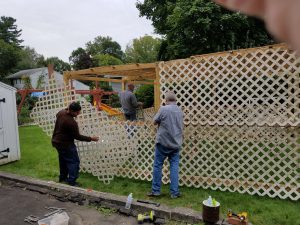
 We live in a world that constantly reminds us of its impermanence. Everything we build, everything we possess, and even the bodies in which we live are temporary. Yet much of human life is devoted to creating permanence and security. We build houses, establish careers, accumulate possessions, cultivate relationships, and make plans for the future. These are good and necessary parts of life, but beneath them lies the unavoidable truth that nothing here lasts forever. Sukkot invites us to confront that reality rather than hide from it. For seven days we leave the security of our permanent homes and dwell in a sukkah, a temporary shelter that reminds us that what appears permanent is, in fact, temporal.
The biblical story itself is a story of people on the move. At Passover we remember Israel leaving Egypt with staff in hand and loins girded, prepared to leave the familiar behind and begin a journey whose destination they could not yet see. They were not simply escaping slavery; they were becoming a people who would learn to live by faith rather than by the securities of Egypt. The wilderness would become their classroom, and the sukkah becomes a yearly reminder that our relationship with God is always, in some sense, a pilgrimage.
Maimonides, in his Guide for the Perplexed, helps illuminate the distinction between the things that sustain us temporarily and those that sustain us ultimately. He writes that “the general purpose of the Torah is twofold, the well-being of the body and the well-being of the soul. The well-being of the soul is ranked first, but the well-being of the body comes first” (Guide for the Perplexed III:27). Human beings have physical needs, and the Torah does not despise them. We need food, shelter, clothing, health, community, and a place to live. Yet these necessities cannot be confused with the ultimate purpose of life. We need shelter for the body, but the soul requires another kind of shelter.
For those of us who confess Yeshua as Messiah, this biblical and Jewish understanding of temporality takes on an additional dimension. Yochanan tells us that “the Word became flesh and dwelt among us” (Yochanan 1:14). The Greek word he uses, eskēnōsen, is related to the language of dwelling in a tent. The God of Israel did not remain distant from the fragile world of human existence. In Messiah Yeshua, God entered our temporary world and pitched his tent among us. The sukkah therefore becomes more than an image of human vulnerability. It can remind us of the mystery that the eternal God chose to dwell among temporal people.
The Shelter of Faith
Israel learned to trust God by living without the ordinary structures of security. They had no permanent homes, no settled fields, and no predictable future. They had manna for the day, water when God provided it, and a cloud and fire to guide them. Their circumstances reminded them that they could not manufacture their own security. They had to learn that God’s faithfulness was more dependable than the permanence of their circumstances.
We tend to equate security with permanence. We want a stable home, a predictable income, good health, dependable relationships, and plans that unfold according to our expectations. There is nothing wrong with these things. Indeed, they are among God’s good gifts. The problem comes when we treat them as ultimate realities.
The rabbis understood the sukkah in this larger framework. One classic explanation is that the sukkot recall the “clouds of glory” with which God surrounded Israel in the wilderness (b. Sukkah 11b). Whether understood as a literal manifestation of God’s presence or as a rabbinic interpretation of the wilderness narrative, the theological point is profound. Israel’s protection did not ultimately come from walls, armies, or permanent structures. Their shelter was the presence of God.
For the follower of Yeshua, this theme reaches its fullest expression in the incarnation. The One who sheltered Israel in the wilderness entered the wilderness of human existence. He experienced hunger and thirst, fatigue and vulnerability, friendship and betrayal. He did not save us by remaining outside our temporal condition. He entered it. Faith, then, is not the denial of uncertainty. It is learning to trust God in the midst of it.
The Shelter of Gratitude
When we move into a sukkah, we become conscious of how much we normally take for granted. We notice the roof over our heads, the walls around us, the warmth of our homes, and the countless conveniences that disappear from our awareness precisely because they function so reliably. The sukkah changes our perspective by temporarily removing us from those ordinary securities.
Sukkot teaches us to see our blessings differently. The house in which we live, the food we eat, the people with whom we share our lives, and the resources that sustain us are not things we have created independently of God. They are gifts. We leave our permanent houses for a few days not because they are bad, but so that we can return to them with greater gratitude.
Sukkot does not teach us to despise the material world. It teaches us not to confuse a gift with its Giver. In a culture in which abundance can easily become invisible, the sukkah restores our capacity for wonder. A meal, a roof, a warm bed, a family gathering, or a beautiful autumn evening can become reasons for thanksgiving because none of them is finally guaranteed.
The same principle lies at the heart of the life of faith in Messiah. We do not begin with what we have earned from God. We begin with what God has given us. Grace itself is gift. The forgiveness we receive, the reconciliation we experience, and the hope we possess in Messiah are not achievements of our own construction. We are sheltered by a grace we did not build.
The Shelter of Connection
Sukkot also reminds us that human beings were never meant to live as isolated individuals. The wilderness was not a journey undertaken alone. Israel became a people by traveling together, eating together, worshiping together, and depending upon one another. The sukkah naturally reflects that communal reality. We invite people into it, share meals in it, tell stories there, and welcome guests.
The rabbis developed the tradition of ushpizin, welcoming honored guests into the sukkah, traditionally including Abraham, Isaac, Jacob, Moses, Aaron, Joseph, and David (Zohar III, 103b). The practice turns the sukkah into more than a shelter for an individual. It becomes a place where generations, stories, and relationships meet.
That is an important corrective to the isolation that characterizes so much of modern life. We have unprecedented means of communication, yet it is possible to be connected to everyone and deeply known by no one. Sukkot calls us back into embodied community.
This has a distinctly Messianic resonance. Yeshua did not call isolated individuals to a private spirituality. He gathered disciples around himself, ate with people, entered their homes, welcomed those who were excluded, and formed a community in which people learned to receive one another as gifts from God. The community of Messiah is a people learning to dwell together under the shelter of God’s grace.
The sukkah reminds us that shelter is not merely something we receive from God. We also become shelter for one another through encouragement, friendship, hospitality, forgiveness, and companionship. In a lonely world, the willingness to make room for another person may itself be a holy act.
The Shelter of Authenticity
There is an honesty about the sukkah that we desperately need. It does not pretend to be permanent or disguise its vulnerability. Its very construction acknowledges that it is temporary, standing in contrast to the ways in which we often construct our lives to appear more secure than they really are.
We spend much of our lives trying to hide our vulnerabilities. We want to appear strong, successful, secure, and in control. Yet beneath those carefully constructed appearances is the reality that the sukkah makes visible: we are temporary creatures. Our possessions, accomplishments, and bodies are temporary. Even the institutions we build and the legacies we imagine will eventually pass away.
The sukkah gives us permission to tell the truth about this. That truth need not produce despair. It can make life more meaningful. When we recognize that our time is limited, we become more attentive to how we use it. We become more willing to love, forgive, reconcile, serve, and say the words that need to be said while we still have the opportunity.
Rav Shaul speaks of “the earthly tent we live in” and contrasts it with “a building from God, a house not made with hands, eternal in the heavens” (2 Corinthians 5:1). The temporary tent is real, but it is not the final reality. Yeshua entered fully into human existence, experiencing hunger and thirst, fatigue and pain, friendship and betrayal, suffering and death. Yet resurrection declares that mortality does not have the final word. Our temporary tents are real, but they are not ultimate.
The Shelter of Prayer
Sukkot teaches us something about prayer. When we recognize that we cannot ultimately secure ourselves, we become capable of praying honestly. Much of our anxiety comes from living as though everything depends upon us. We imagine that if we plan carefully enough, work hard enough, anticipate every possibility, and control enough variables, we can make ourselves secure. The sukkah gently dismantles that illusion.
This is reflected in the liturgy of the festival. Beginning with Sukkot, we add Mashiv ha-ruach u-morid ha-geshem, “Who makes the wind to blow and the rain to descend,” to the second blessing of the Amidah. We acknowledge that the very forces upon which agricultural life depends are beyond our control. The prayer is not simply a request for favorable weather. It is a confession of dependence.
Prayer is therefore not an attempt to control God. It is an act of surrender. We bring our fears, hopes, needs, gratitude, and questions into the presence of the One who holds our lives. Sitting beneath a roof that allows us to see the sky reminds us that there are realities beyond our control. The wind may blow, the rain may come, and the sukkah may shake, but God remains God.
For those who follow Yeshua, prayer becomes participation in the relationship that Messiah has opened for us. We do not pray as people attempting to convince a distant God to notice us. We pray as people who have already been invited into God’s presence. The One who pitched his tent among us has opened the way for us to dwell with God.
The Shelter of Awe
Finally, Sukkot leads us toward awe. When we step outside the walls of our permanent homes and sit beneath the open sky, we recover a sense of wonder. We remember that the world is larger than our plans and that our lives are part of something much greater than ourselves.
The sukkah is deliberately incomplete. Through its roof we see the sky and the stars and experience the weather. We are reminded that we are creatures living within creation rather than masters standing above it. The experience can produce humility, but it can also produce joy. Indeed, Sukkot is Zman Simchateinu, the Season of our Joy. We are commanded to rejoice precisely while being reminded that everything is temporary.
The Torah does not tell us to wait for permanence before we can experience joy. Instead, it teaches us to discover joy in God’s presence in the midst of impermanence. The sukkah does not promise that the storm will never come. It reminds us that God is present even when it does.
Perhaps that is why Sukkot is such an appropriate image for the life of faith. We are not promised that our earthly shelters will last forever. We are promised God’s presence. We are not promised control over the journey. We are promised that God will accompany us. And in Messiah Yeshua, we see the ultimate expression of that promise. The eternal Word entered our temporary world, pitched his tent among us, and opened the way toward a dwelling that is not temporary.
The shelter we build is temporary, but the One who shelters us is eternal.
We will eventually leave our sukkot. The branches will come down, the decorations will be packed away, and we will return to our houses and resume the ordinary rhythms of life. But perhaps we will return with a different understanding of what a house really is. Our homes are gifts, but they are not our ultimate dwelling place. Our possessions are blessings, but they cannot guarantee our future. Our bodies are temporary tents, but they are not the whole story. Our lives are journeys, and we remain sojourners in this present reality.
Sukkot teaches us to live faithfully within that tension. We can build homes without imagining that they are permanent. We can enjoy the good things of this world without worshiping them. We can love deeply without pretending that anything in this life is guaranteed to last. We can give thanks for what we have while trusting God with what we cannot keep.
Ultimately, we can rest in the promise that the God who traveled with Israel through the wilderness has not abandoned his people. In Messiah Yeshua, he has entered our temporary world, pitched his tent among us, and opened the way toward a dwelling that is not temporary. We live in a temporal world, but we do not have to live without shelter.