
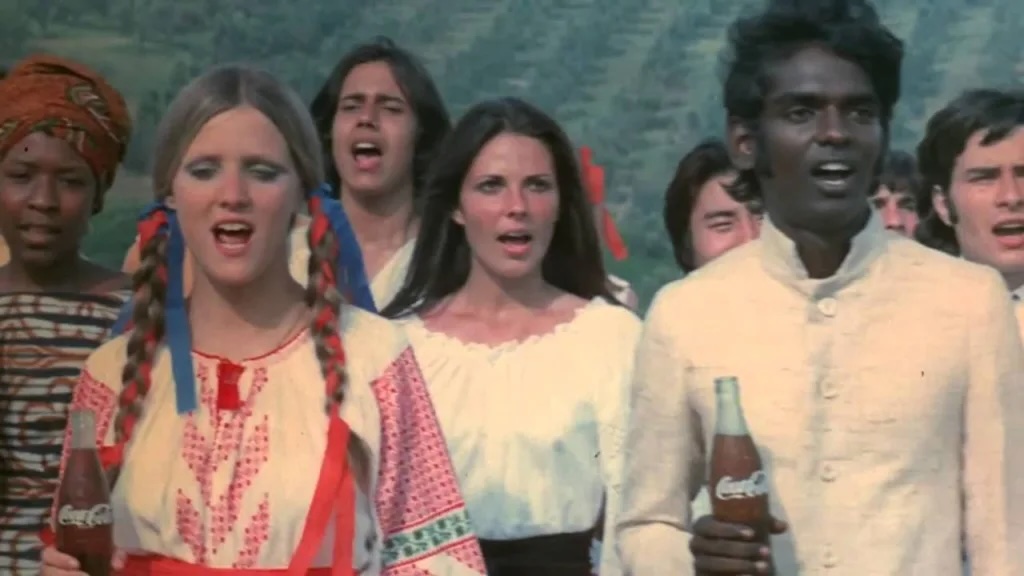
Imagine, just for a moment, if I asked everyone to join hands and we played that old Coca‑Cola jingle from the early 1970s: “I’d like to teach the world to sing, in perfect harmony.” It was the perfect fusion of 1960s universalist idealism and American commercialism. Peace, harmony, wholeness, and equality—sold to us in a bottle.
Andy Warhol tried to capture this same idea when he painted Coke bottles and Campbell’s soup cans. The claim was simple: the Queen of England could not buy a better Coke than the average subway rider. What Warhol failed to mention, of course, was that the Queen drank her Coke on a silver tray, served by attendants in Buckingham Palace—and that Warhol himself made millions off these images, enabling him to buy far better Coke than the average commuter ever could.
The ideals themselves were not wrong. Peace, harmony, and equality are deeply biblical values. What the generation of the 60s failed to recognize was that they were trying to reach those ideals using the very same self‑reliance and value systems that had already failed so many times before. In Parashat B’shelach, we encounter a very different vision of how the world is truly taught to sing.
The Song of Moses
At the heart of this parashah stands Shirat HaYam, the Song at the Sea (Exodus 15:1–19). This song does not live only in the biblical past; it is woven into Jewish daily prayer as a climactic moment within Shacharit, forming the core of the final blessing that concludes the morning Shema, where Israel blesses HaShem as the Redeemer who brought His people through the Sea. This is not merely poetry added to the narrative; it is the theological center of the story. Israel does not sing because they planned liberation well, or because their military strategy succeeded. They sing because God acted.
For the first time as a people, Israel publicly and fully accepts the Kingship of Heaven. “The Lord will reign forever and ever” (Exod. 15:18). Rabbinic tradition recognizes this moment as foundational. The Talmud links the remembrance of the Exodus with the daily affirmation of divine sovereignty (b. Berakhot 12b), and the liturgy intentionally echoes the language of the Kedushah, aligning human praise with that of the angels: Mi khamokha ba’elim Adonai? Who is like You among the mighty, O Lord?
This song blesses God as Redeemer of Israel. It is not accidental that the blessing of redemption in the Shema cycle recalls the Sea and the Song. Creation establishes God’s sovereignty; redemption reveals His mercy and power; and Israel’s response is praise and obedience. The world is not redeemed by idealism alone, but by the decisive action of God on behalf of His people.
Pharaoh, Amalek, and the Long Road
There is something striking about the structure of this parashah. The third word is Pharaoh. The third-to-last word is Amalek. This literary framing device, called an inclusio, forces us to read everything in between in light of these two figures.
Pharaoh represents oppression at its most absolute: enslavement, infanticide, and the attempt to erase Israel entirely. Amalek represents a different threat—the first to attack Israel with the sword, striking the weak and the weary from behind. Though these figures are long gone historically, their spiritual legacy persists. The hatred of Israel did not end at the Sea or in the wilderness. It reappears again and again, wearing new faces in every generation.
Yet the Torah does not rush us from Pharaoh to Amalek. Instead, it lingers in the wilderness, because the most difficult struggle is not only against enemies outside the camp, but against forgetfulness within it.
The Human Tendency to Forget
After witnessing the splitting of the Sea, Israel complains about water. After manna falls from heaven, they complain about food. They even long nostalgically for Egypt. The Psalmist captures this tragic rhythm: “They soon forgot His deeds; they did not wait for His counsel” (Psalm 106:13).
This is not a uniquely Israelite flaw, and it must never be weaponized as anti‑Jewish polemic. It is a profoundly human one. The more we receive, the more our expectations grow. Gratitude gives way to entitlement. In groups, this tendency is amplified—groupthink, mob mentality, and self‑interest crowd out responsibility for the common good.
Miracles alone do not mature human character, no matter how dramatic or overwhelming they may be. Redemption requires formation: education, discipline, sacrifice, and shared values over time. That is why God does not take Israel by the shortest route.
The Long Road to Maturity
“When Pharaoh sent the people, God did not lead them by way of the land of the Philistines, though it was nearer” (Exod. 13:17). God feared that a premature confrontation would drive them back to Egypt. So He led them the long way—through the wilderness, through the Sea, and eventually to Sinai.
That detour was not a mistake; it was mercy. Along the way, Israel learned dependence, trust, and obedience. Along that path they would receive the Torah, their inheritance and vocation. Formation takes time, and freedom without formation collapses back into slavery.
It may feel presumptuous to compare ourselves to the giants of Scripture. Yet wilderness stories endure precisely because they mirror our own lives. We, too, stand between a past that still tugs at us and a future that frightens us. Growth is unsettling. Responsibility is heavy. But we are not sent alone.
The Song of the Lamb
The prophets and the apostles insist that the Song at the Sea is not the final song. In the book of Revelation, John hears a new song in heaven—the Song of the Lamb (Rev. 5:8–14). Later, it is explicitly called “the song of Moses, the servant of God, and the song of the Lamb.”
Here, the redemption celebrated at the Sea finds its fulfillment. What Israel first sang on earth is taken up into heaven. The kingship first confessed by a liberated slave people is now acknowledged by every creature in heaven and on earth. Creation, revelation, and redemption converge in Messiah.
Praying Blessings in Messiah
When the blessings surrounding the Shema are prayed in Messiah Yeshua, their depth becomes even clearer. Messiah is confessed as the Divine Word and Wisdom through whom creation came into being, the true light that enlightens every human being. With the Father, He is sanctified and glorified by the heavenly hosts.
In the blessing of redemption, the Sea and the Cross are held together. Through Messiah’s death and resurrection, and through the gift of the Ruach, the Torah is written on human hearts. Israel’s calling to accept the yoke of the divine kingship is not abolished but fulfilled—made possible by God’s own initiative.
The goal toward which these blessings point is nothing less than the full acceptance of the Kingship of Heaven on earth as it is in heaven. What the angels proclaim eternally, what Israel first sang at the Sea, what Messiah embodied perfectly—this is the destiny of all creation.
Our Song
So where does that leave us?
We are still being sent. If we take the first two and the last two words of the parashah together, we hear a quiet but powerful message: Vayehi beshalach… me’dor dor, “And it was that God sent them, from generation to generation.” From Egypt, Israel was sent to sing a song of liberation. And that sending has never stopped.
God is still our banner, Adonai Nissi. The path may not be the one we would choose. The road may be longer and harder than we expect. Pharaoh still chases from behind, and Amalek still waits ahead. Yet the same God who split the Sea still goes before His people.
The world does not need another shallow harmony or sentimental anthem. It needs a people who have been formed by redemption, disciplined by Torah, and sustained by hope. When we lift the banner of Messiah and walk forward together—sometimes trembling, sometimes weary, but always trusting—we join our voices to an older, deeper song.
A song first sung by the Sea. A song echoed daily after the Shema. A song taken up in heaven as the Song of the Lamb. And one day, when the Kingship of Heaven is fully received on earth, it will be the song by which the whole world finally learns to sing in perfect harmony.