
Seeing Giants or Seeing God?
This week’s portion, Shelach Lecha, contains several obvious themes within a familiar narrative: Be bold. Do not fear. Trust God. The majority is not always right.
The context, of course, is the story of the twelve spies sent into the Promised Land. Ten of the twelve returned with a troubling report: “The land is filled with giants,” and “we were like grasshoppers in our own eyes” (Bamidbar 13:33). The ten spies could see only the challenges before them, while the two faithful spies saw evidence of God’s promises in the abundant produce of the land (Bamidbar 13:23-27).
In stark contrast, the spies in our Haftarah portion offer a renewed sense of hope. They enter Jericho after forty years of wandering and emerge with a completely different assessment than their predecessors: “Truly the Lord has delivered into our hands all the land; moreover, all the inhabitants of the land melt before us” (Joshua 2:24).
Not surprisingly, the discipline of the wilderness produced a very different outlook. Israel had learned to trust the God of Israel through years of trials and challenges, living without any guarantees of safety or provision beyond His faithfulness. Yet there is another story embedded in this Haftarah, one that contains a significantly different set of themes if we pay attention to what Christian theologian Walter Brueggemann calls the “counter-narrative.”
The Woman in the Wall
To discover it, we must focus on another character in the story: the enigmatic Rahab.
We are not introduced to Rahab until the two spies arrive at her establishment. She not only shelters the spies but also risks her own life and the lives of her extended family to protect them. In doing so, she chooses to stand with Israel rather than with her own people. She places her trust in the promises of Israel’s God and abandons the false security offered by the gods of her city.
But who is Rahab?
The text tells us that the two spies came to “the house of an ishah zonah, whose name was Rahab” (Joshua 2:1). At first glance, this raises an obvious question: Why would two Israelite spies seek lodging in the home of a prostitute, as zonah is traditionally translated?
As he often does, Rashi offers a more sanitized interpretation. Citing Targum Jonathan, he explains that zonah here means pundekita, an Aramaic term referring to a seller of food, such as an innkeeper or shopkeeper. The interpretation of “innkeeper” makes particular sense in this context, since the spies came there to stay. Other commentators maintain that Rahab was indeed a prostitute. Perhaps she was both.
Whatever her precise occupation, Rahab appears to have occupied a marginal social position. She seems to have little attachment to her city, and she was a woman conducting business in a world that largely valued women for their reproductive roles. Yet despite her status, she emerges as one of the most remarkable figures in the biblical narrative.
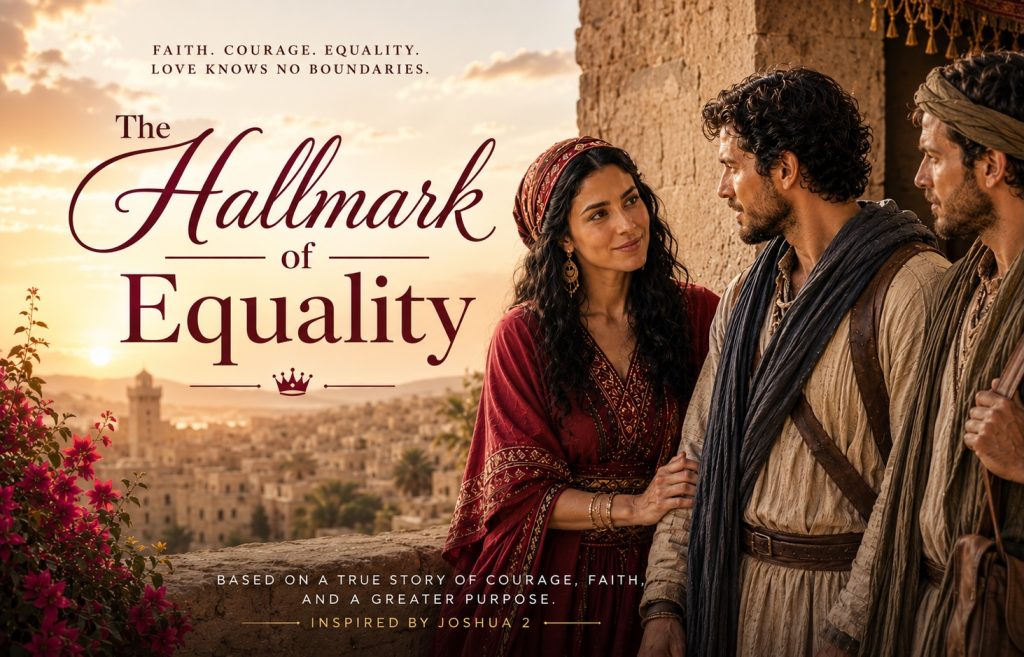
A friend once suggested that Rahab would make an interesting Hallmark movie heroine. From my admittedly limited exposure, those films often follow a familiar pattern: a woman entrepreneur leaves behind a small and confining existence in pursuit of success, only to discover that true fulfillment lies elsewhere.
The comparison is imperfect, but Rahab was indeed an entrepreneur struggling to survive in a world where women’s options were often severely limited. Yet she found both purpose and a future by identifying herself with another people and another God while remaining in her own hometown.
As a result, Rahab secures an enduring place in Israel’s story. She is listed among the great heroes of faith (Hebrews 11:31) and even becomes part of the ancestry of Yeshua the Messiah (Matthew 1:5).
Firstfruits of the Nations
Rahab’s story is significant for another reason. Before Israel’s conquest of the land has truly begun, a woman from the nations has already found refuge among the people of Israel. In this sense, Rahab becomes a kind of firstfruits of the nations. Long before the prophets envisioned the nations streaming to Zion and joining themselves to the God of Israel, Rahab embodied that hope.
She stands as a testimony that God’s redemptive purposes were never limited to ethnic Israel alone, but always pointed toward a future in which people from every nation would find their place among His covenant people.
The conquest narrative begins not merely with judgment, but with mercy. Before the walls of Jericho fall, grace has already entered the city.
Living in the Greater Reality
Rahab’s inclusion among the people of Israel anticipates a truth that Rav Shaul would later articulate in Galatians 3:28. In the Messiah, distinctions such as Jew and Gentile, slave and free, male and female no longer determine a person’s standing before God. We are being united into one people in the Messiah.
Rav Shaul is not suggesting that our differences cease to exist. Rather, he is pointing us toward a greater reality, one in which the hierarchies and divisions that characterize the present age are giving way to the unity of the age to come.
Rahab was a Gentile woman trapped in what appeared to be a dead-end existence until God brought down the very walls that confined her. Her story reminds us that God’s purposes are often larger than the boundaries we construct for ourselves and for others.
As followers of the Messiah, we are called to live in light of that future reality now. Like Rahab, we are invited to see beyond the barriers that separate people and to recognize the image of God in every human being. It is incumbent upon us to seek that greater reality and to treat one another accordingly, as men and women created in the image of the Holy One of Israel.
That is the true hallmark of equality.